Big Science Question
23 January 2026
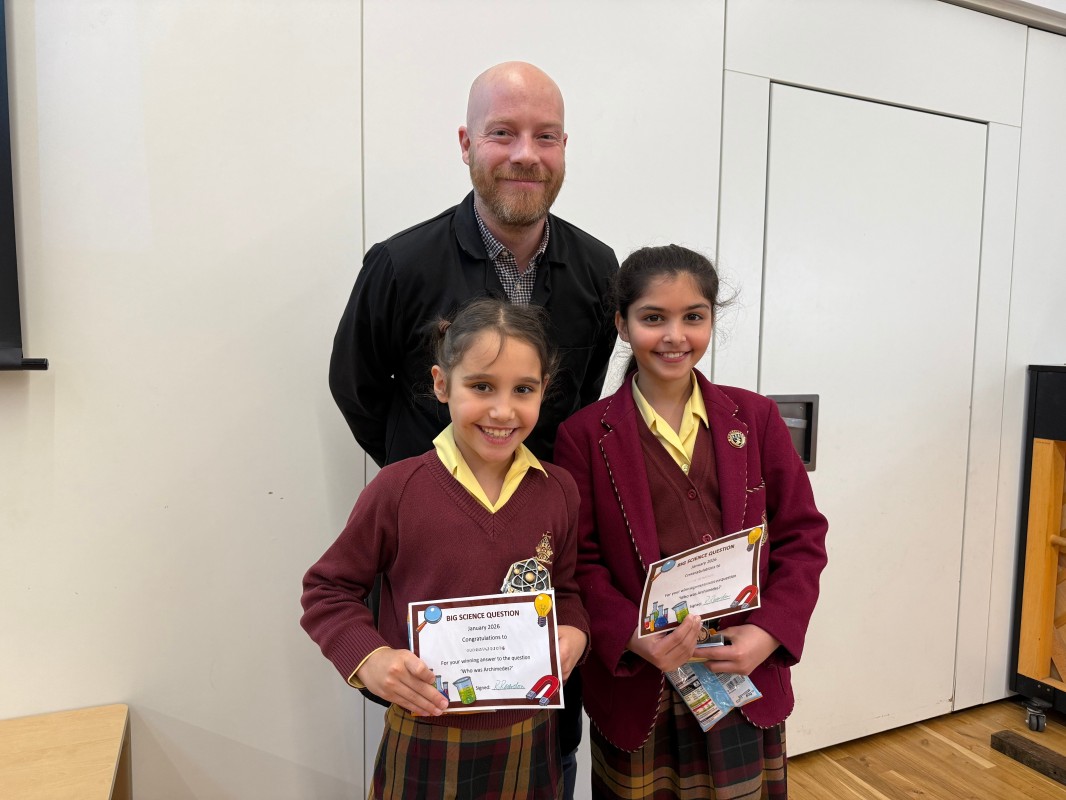
Our latest Big Science Question assembly focused on the life and work of the ancient Greek mathematician and scientist Archimedes, whose discoveries continue to influence science and engineering today.
The children explored how his ideas about forces and motion apply to everyday situations through a series of engaging practical investigations. One key area was levers and their ability to magnify force. This was demonstrated by pulling nails from wood with ease and even lifting Mr Reardon, clearly showing how a small effort can move a much larger load when the lever is used correctly. They then investigated pulleys and discovered how changing the arrangement of ropes and wheels reduces the force needed to lift heavy objects. In one demonstration, a pupil was able to lift a 3kg weight using only 9 newtons of force!
The assembly also examined gears, using bicycles as a familiar example to show how different gear ratios make cycling easier or harder depending on the terrain. Finally, they explored floating and buoyancy through water displacement, demonstrating Archimedes’ principle and explaining why objects float or sink. All of this brought Archimedes’ work to life, combining history with hands-on experiments that made complex scientific ideas easy to understand and memorable.
Congratulations to our winners, Mabel C and Clara R. Our next question was asked by Diya N, who would like to know, 'How Does Electricity Work?'